
Two reasonable options, not a contest
Drivers are often told, by friends or by ads, that one option is always better than the other. In practice both can produce a working key, and the better choice depends on the vehicle, where it is, what time it is, what documents you have and how quickly you need to be moving. A dealership has a direct relationship with the manufacturer. A mobile locksmith comes to the car. Those two basic facts shape most of the differences.
This page does not argue that one costs less or moves faster in every case, and it does not claim that either always works for every vehicle. Quotes from a locksmith are given by phone only, and some situations need an on-site look first. What follows is a plain description of how each route usually unfolds, what questions to ask and what to prepare. If you finish reading and still are not sure, a call to a locksmith to describe your vehicle can clarify which path makes sense, and a call to the dealership service department can do the same from their side.
Everything here applies to ordinary passenger vehicles. Unusual, rare or very new models can have restrictions that neither route can resolve quickly, and the person you speak with will tell you if that applies.
How the dealership route usually works
At a dealership, a replacement key typically starts with a visit or a call to the service or parts department. Staff will want to confirm the vehicle and your ownership, using the vehicle identification number and your identification. For many brands the key is ordered, cut and programmed at the dealership. Depending on the model, parts may be on hand or may have to be ordered, and that affects how long the process takes.
A dealership works with the manufacturer's own systems and parts. For some vehicles, especially recent or less common models, that access can matter. A dealer can also handle manufacturer coverage questions, recalls and other work in the same visit. These are real advantages, and they are worth weighing if your situation involves any of them.
The practical constraints are location and hours. The dealership is a fixed place with business hours, and if every key is lost, the vehicle generally has to be brought there. That brings up the question of towing, discussed below. If the vehicle can be moved easily or is already parked nearby, the dealership route is simpler. If it is stuck in a parking structure far away at night, it is a longer process.
- Manufacturer parts and systems, which can matter on newer or less common models.
- Can combine key work with recall or other service in one visit.
- Fixed location and business hours.
- Parts may need to be ordered, which affects timing.
- If all keys are lost, the vehicle usually has to be transported to the dealership.
How the mobile locksmith route usually works
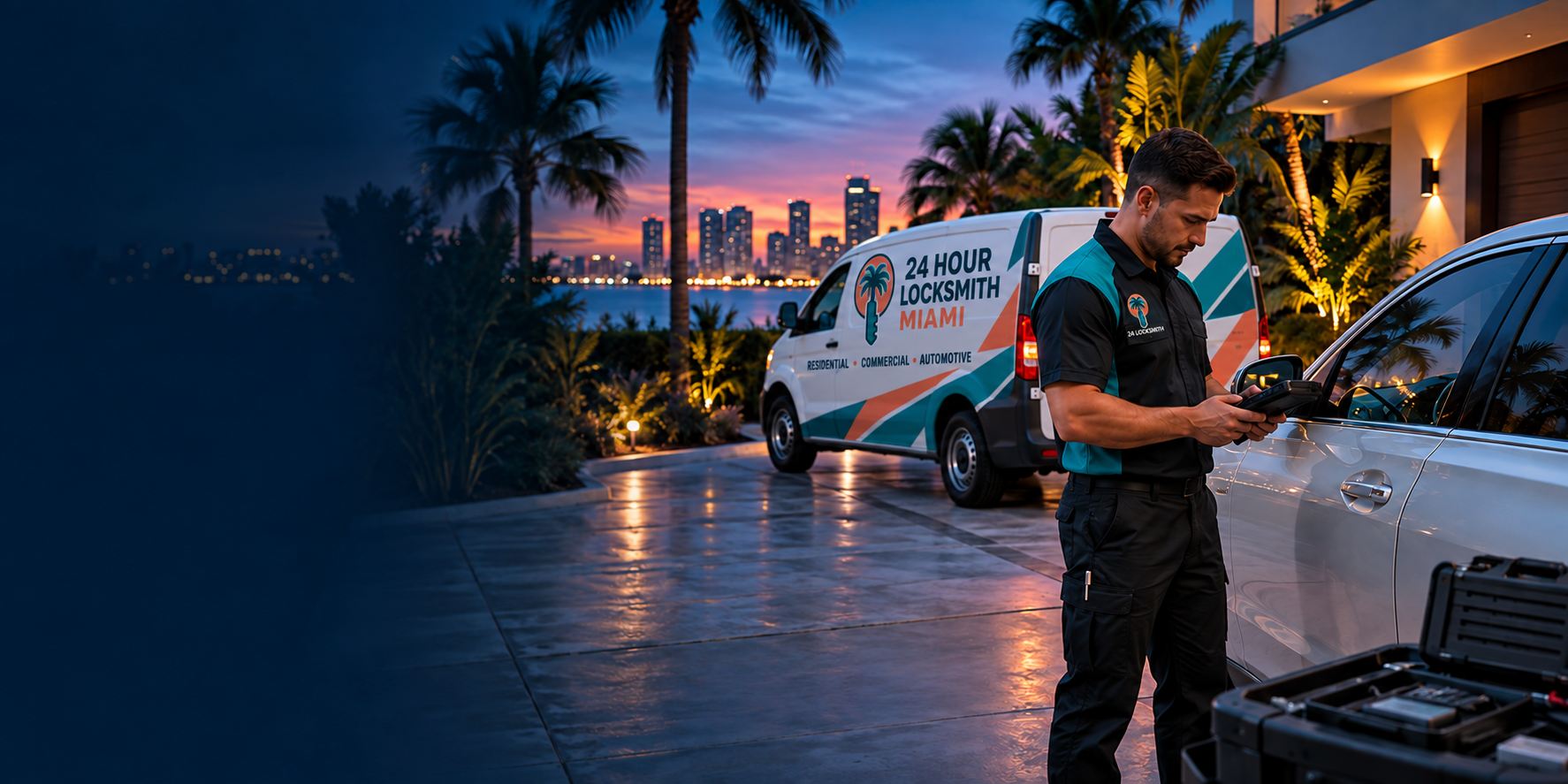
A mobile locksmith comes to where the vehicle is. You call, describe the vehicle, hear how the job would work and what the quote is, and, if you agree, a technician is dispatched. A service call charge applies and is explained on the phone before anyone is sent. For simple jobs a quote can usually be given by phone. For more complicated jobs, an on-site look may be needed before the final figure is set.
On arrival, the technician confirms who you are and that you are entitled to the vehicle, then identifies the key system and carries out the work, which may include cutting the blade and programming the new key to the car with diagnostic equipment. You test the key before the job is closed. For many common vehicles, this happens in a parking space or a driveway, and the car never has to be moved.
The limits are worth knowing. Not every vehicle can be handled by every mobile locksmith, because the equipment and software needed vary by brand and model year. Some very new or specialized models may be beyond what a particular technician can do in the field, and a good technician will say so on the phone rather than send someone out and discover it on site. If that happens, the dealership may be the right route after all.
The towing question
If all keys are lost and the car cannot be started, getting it to the dealership can mean a tow. Whether that is a large part of the overall effort depends on where the vehicle is. A car in your own driveway a short distance away is a small problem. A car left in a distant parking area, or one that is blocking something, is a larger one.
A mobile locksmith avoids the tow in most cases, because the work is done where the vehicle sits. That is one of the clearest practical differences between the two routes, and it can matter a lot at night or in a location where you do not want to wait around. But it is not an absolute advantage. If the vehicle turns out to need work the technician cannot perform on site, a tow may be needed anyway, and you will have used time finding that out.
Whichever route you choose, ask directly: does the vehicle need to move for the work to be done? The answer should be a plain yes or no after you describe the situation. If you are in a place that feels unsafe, put your own safety ahead of any plan, and see our page on being locked out of your car in a parking lot for how to choose a spot to wait.
Timing, hours and what affects both
Time is often the deciding factor, and it is the area where it is easiest to be misled. No honest source can promise how quickly a key will be ready in a given case. Availability depends on the day, the vehicle, the parts, the technician's schedule and the location. A dealership may have the key blank on the shelf or may need to order it. A locksmith may be on a job elsewhere or may be close by. Be wary of anyone who gives you an exact arrival or completion window before knowing the details.
Business hours matter. A dealership service department keeps regular hours that vary by location, and many are closed late at night and on some days. A locksmith service that describes itself as 24-hour is describing a service concept, not a promise that a technician is available at every hour and in every place. When you call, ask what is realistic for your location and your vehicle that day.
If you need the vehicle for something time-sensitive, such as getting to work or picking up a child, tell whoever you speak with. It may change which route they suggest, and they may be able to tell you honestly that another option is faster for your case.
Documentation and proof of ownership
Both routes require you to show you are entitled to the vehicle. This is not bureaucracy for its own sake. Making a working key is the same as making the ability to drive the car away, and responsible providers ask for proof before doing it. Expect to show a photo ID, and registration or other ownership documentation that matches. If the vehicle is leased or company-owned, additional paperwork may be needed, such as a letter of authorization.
Having these documents ready speeds up either route. If the registration is in the glove box of a locked car, that is a common snag, and it is worth thinking about before you call. Some people keep a photo of the registration on their phone, or a digital copy, which a provider may accept in some situations. Ask what is acceptable rather than assuming. Our page on proof of ownership for car key service describes what is commonly requested and why.
If you are not the owner, for example you are driving a relative's car or a car you recently bought but have not retitled, tell the provider at the start. They can explain what they need, and it is far better to learn that on the phone than after a technician has traveled to you.
- Gather your photo ID.
- Find the registration, title or other ownership document, or a clear photo of it.
- Note the vehicle identification number, found on the dashboard near the windshield and on the registration.
- If you are not the registered owner, ask what authorization the provider will accept.
- Tell the provider about any liens, leases or company ownership right away.
Questions to ask either one
The same set of questions works for a dealership and for a locksmith. A provider who is confident in the work will not mind them, and the answers will tell you more than any advertisement.
Ask whether they can do your specific make, model and year, and how many keys they can provide. Ask what is involved from start to finish, including whether the car has to move. Ask what the charge covers and whether anything could change it, and ask for the details by phone before anyone is dispatched or the car is moved. Ask whether the old keys will keep working and whether lost keys can be removed from the car. Ask what happens if the new key does not work as expected.
Be cautious of anyone who will not explain the process, who pressures you to decide at once, or who gives a different answer each time you ask the same question. If you are talking to a locksmith, our guide on questions to ask before hiring a locksmith has a longer list.
Situations where each tends to make sense
These are examples, not rules. A dealership tends to make sense when the vehicle is very new or uncommon, when you are already planning recall or other manufacturer service, when the vehicle is nearby and easy to bring in, or when a locksmith tells you honestly that your model is beyond what can be done in the field. The weight of that last point should not be underestimated, since a straightforward answer from a technician is a sign of a trustworthy provider.
A mobile locksmith tends to make sense when the car is stuck somewhere inconvenient, when it is outside dealership hours, when you want to avoid a tow, when you need a spare made without making a trip, or when the vehicle is a common model with well-supported equipment. If you are at home with a spare needed and a working key in hand, scheduling a locksmith visit to the driveway can be a calm way to get it done. Our page on spare car key programming describes how that usually goes.
Some people use both: a locksmith for an urgent replacement, and the dealership later for something unrelated. There is no rule against it.
How the vehicle itself changes the picture
Some of the difference between the two routes comes from the car rather than the provider. A common sedan, hatchback or pickup from a mainstream brand, with a key system that has been on the market for years, is the kind of vehicle that many mobile technicians handle regularly. A luxury model, a very recent redesign, an imported model with an unusual security system or a vehicle that uses a manufacturer-specific online approval step may be harder to work on outside the dealership.
Age matters too. A vehicle from the era of simple chip keys is generally more approachable than one with a fully encrypted smart key. A vehicle old enough to have no chip at all may need only a cut blade, which is a different and simpler job. In Miami-Dade, where many households own a mix of older family vehicles and newer leased ones, it is common to need advice for more than one kind of key in the same family.
Our brand pages, such as BMW and Mercedes key replacement, describe in general terms how key systems differ by manufacturer. They are a good way to prepare for the conversation, but the technician or the service advisor who checks your actual vehicle has the last word.
What can go wrong with either route
Every route has some friction. At a dealership, the usual problems are scheduling, parts that must be ordered, and the need to get the car there. At a locksmith, the usual problems are availability at the moment you call and the occasional vehicle that turns out to need equipment the technician does not carry. Neither of these is a scandal. They are ordinary limits, and good providers describe them honestly.
The more serious problems come from poor information. A provider who tells you what you want to hear on the phone and then changes the story on arrival is a problem on either route. A provider who starts work before explaining the charge is a problem. A provider who cannot say what they will do to your car is a problem. If you notice any of these, pause and ask for an explanation before anything is done to the vehicle.
Our guide on how to verify that a locksmith is legitimate lists practical checks you can make before agreeing to a visit, and the same habits of asking and verifying serve you well at a dealership counter.
Deciding calmly and calling
Stress pushes people toward the first option they see. If you can spare a few minutes, write down your vehicle details, check where your ID and registration are, and decide whether the car can be moved. Then make one or two calls and compare what you hear: what is involved, whether the vehicle has to move, what the service call charge is, how the quote is given and what proof they need.
A locksmith quote is given by phone, and for a complicated job a visit may be needed before the final figure. Nothing should be a surprise on arrival. If something changes on site, the technician should explain it and let you decide. You can always decline.
If you decide to try a locksmith, call, describe your vehicle and your location, and ask whether the job can be done where the car is. A technician will tell you plainly what is possible, and if it is not something they can do, they will say so.
Questions people ask
Is a dealership always more reliable for car keys?
Not always, and not never. A dealership has direct access to manufacturer systems, which can matter for very new or uncommon models. A mobile locksmith with the right equipment can handle many common vehicles on site. Reliability depends on the specific provider and vehicle, so ask both whether they can do your make, model and year before deciding.
Will I need to tow my car if I use a locksmith?
In most common cases, no, because a mobile technician works where the vehicle is. But some vehicles or situations cannot be completed in the field, and a tow might still be needed. Ask during the first call whether the work can be done on site for your vehicle, and a technician can tell you plainly.
What documents will either one ask for?
Typically a photo ID and registration or other ownership documentation that matches. For leased, company or recently purchased vehicles, extra paperwork may be needed, such as a letter of authorization. Gather these before you call, and tell the provider if you are not the registered owner so they can explain what is acceptable.
Can anyone promise how fast my key will be ready?
No honest provider can promise an exact window without knowing the vehicle, location, parts and schedule. Treat precise time promises given before details are known with caution. Ask what is realistic for your case on that day. A 24-hour service is a service concept, not a promise of a technician at every hour and place.
How are locksmith quotes given?
By phone only, after you describe the vehicle and the situation. A service call charge applies and is explained before anyone is dispatched. Complicated jobs may need an on-site look before the final figure is settled. You can decline if something changes on site. Nothing should be a surprise when the technician arrives.
Can I use both a dealership and a locksmith?
Yes. Some drivers use a locksmith for an urgent replacement and a dealership for unrelated service later, or the reverse. Nothing prevents you from comparing the two by phone before choosing. If a locksmith tells you your vehicle is beyond what can be done in the field, the dealership may be the right next call.
Describe the situation by phone and we will tell you what the job involves. Quotes are given by phone. Jobs that cannot be quoted without seeing them need a technician on site, and the service call charge is explained on the phone before anyone is dispatched.
(786) 539-3980Related pages
Written by Claude (AI) (AI) for 24 Hour Locksmith Miami.